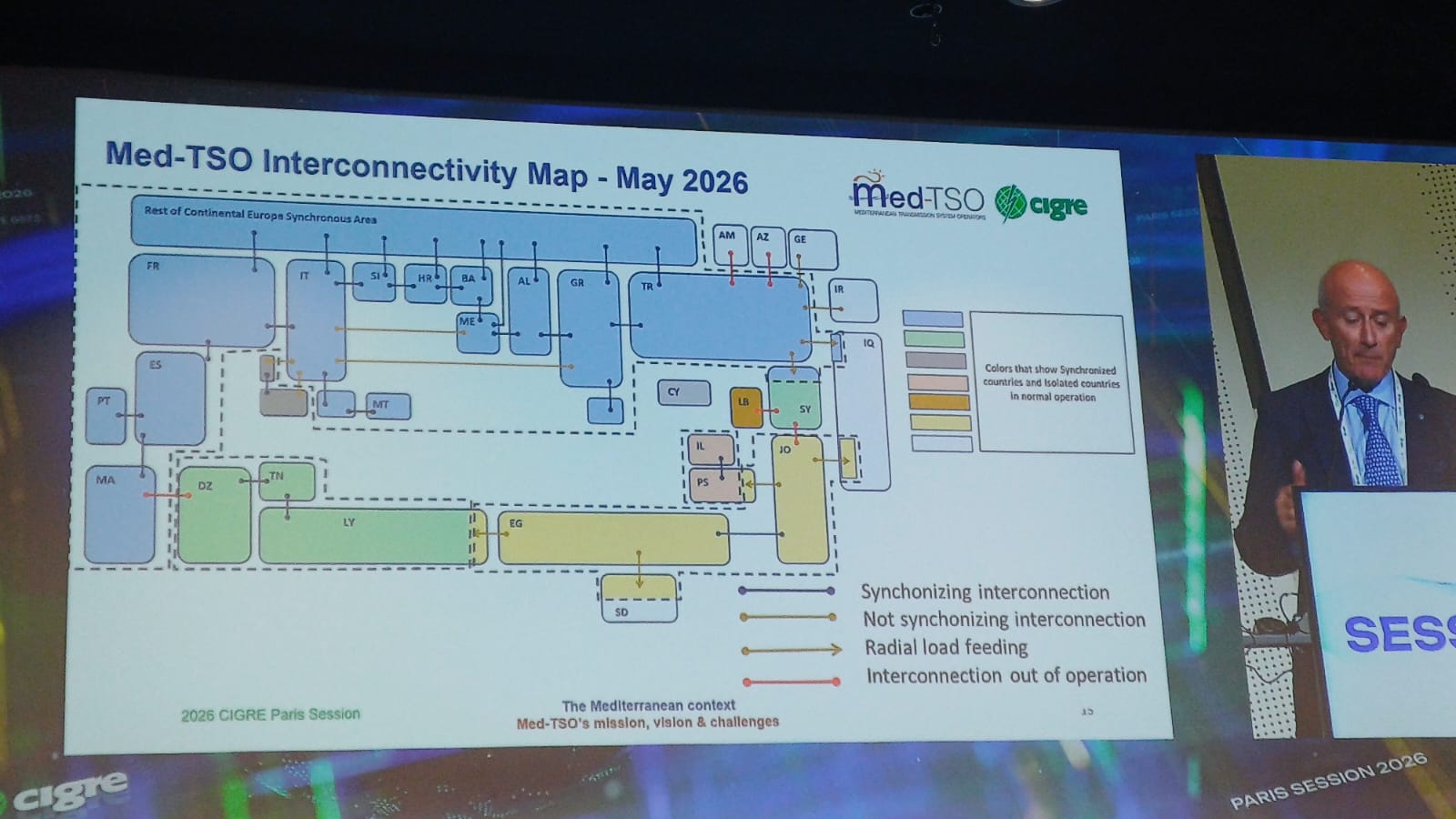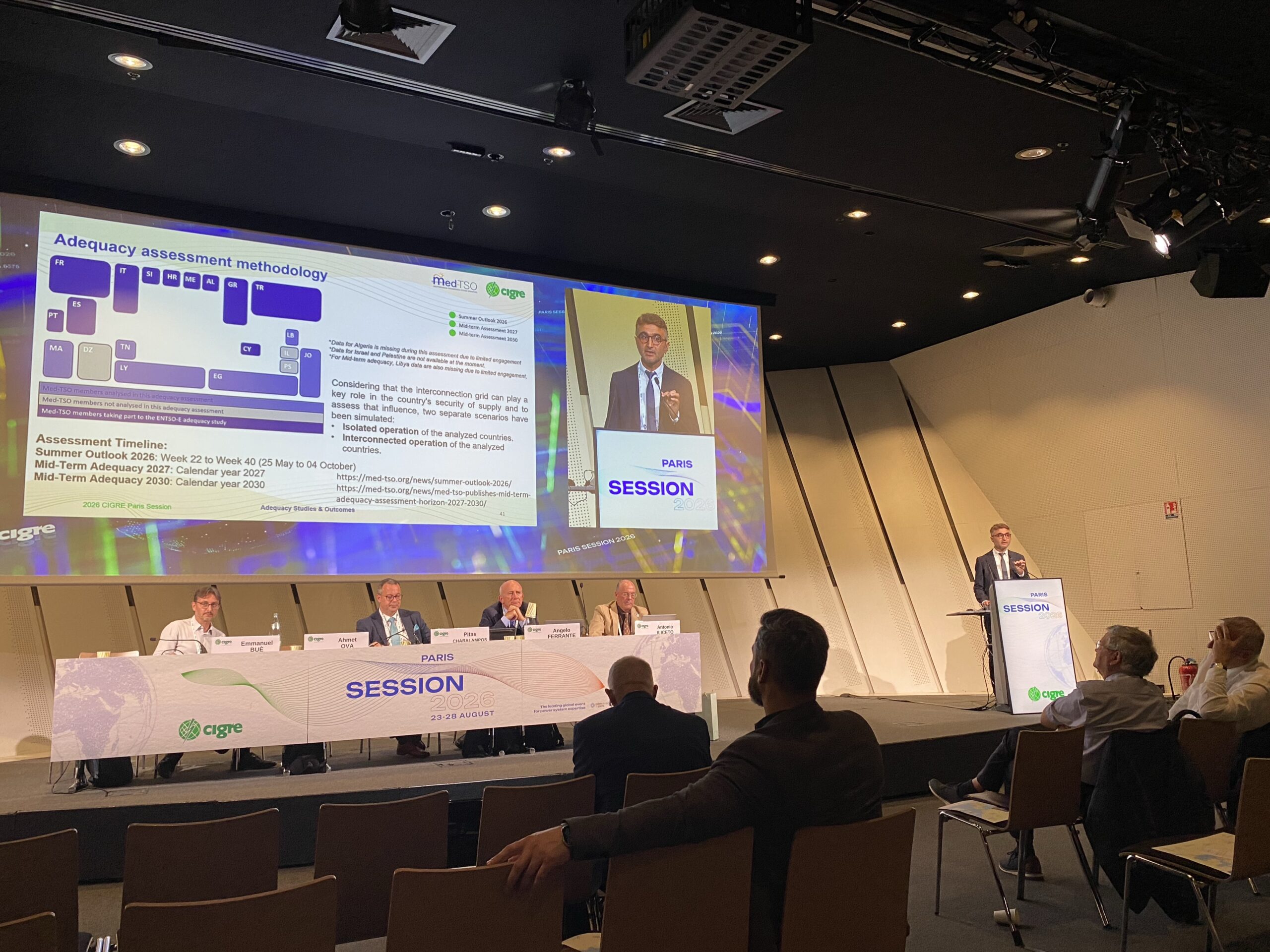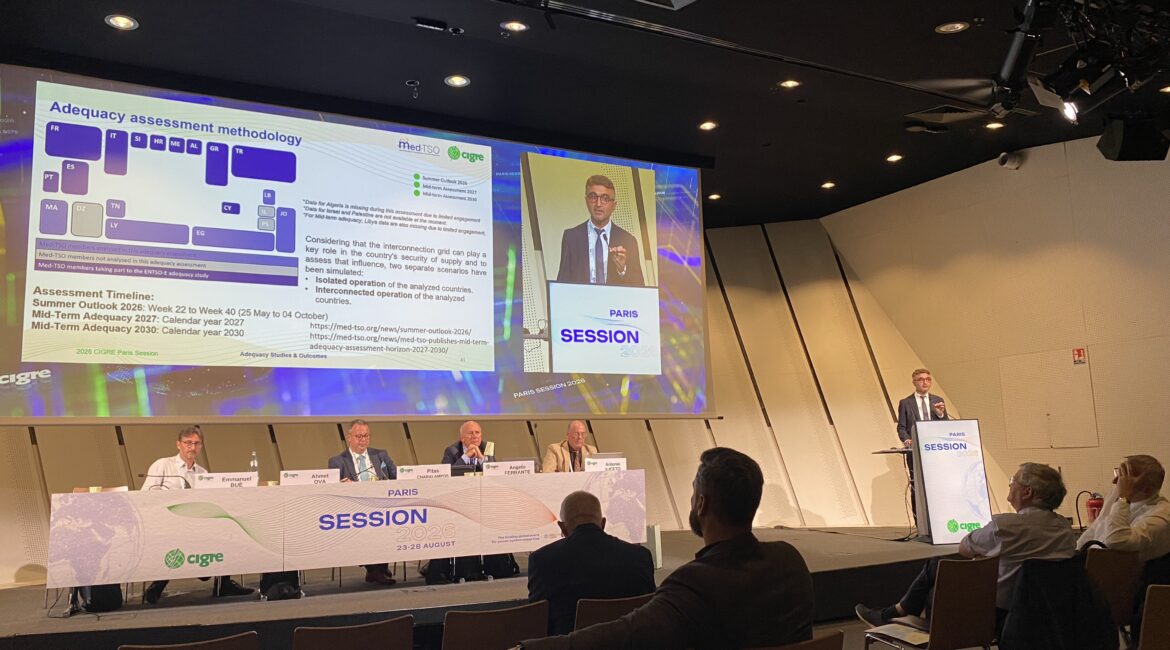
On 25 August 2026, Med-TSO brought the Mediterranean energy transition to the forefront of the CIGRE Paris Session with the workshop “Med-TSO and the Mediterranean Power Systems in Transition – Challenges, Cooperation, and the Path to Security” showcasing how regional cooperation, coordinated planning and technical analysis are helping to build a more integrated, secure and sustainable Mediterranean power system.
The event addressed some of the most pressing challenges facing the region, including rapidly increasing electricity demand, the large-scale integration of renewable energy sources and growing adequacy concerns, particularly across the Middle East and North Africa. As the unique association connecting European and MENA transmission systems, Med-TSO highlighted its role in supporting evidence-based decision-making through data collection, long-term planning studies and technical cooperation among Transmission System Operators.
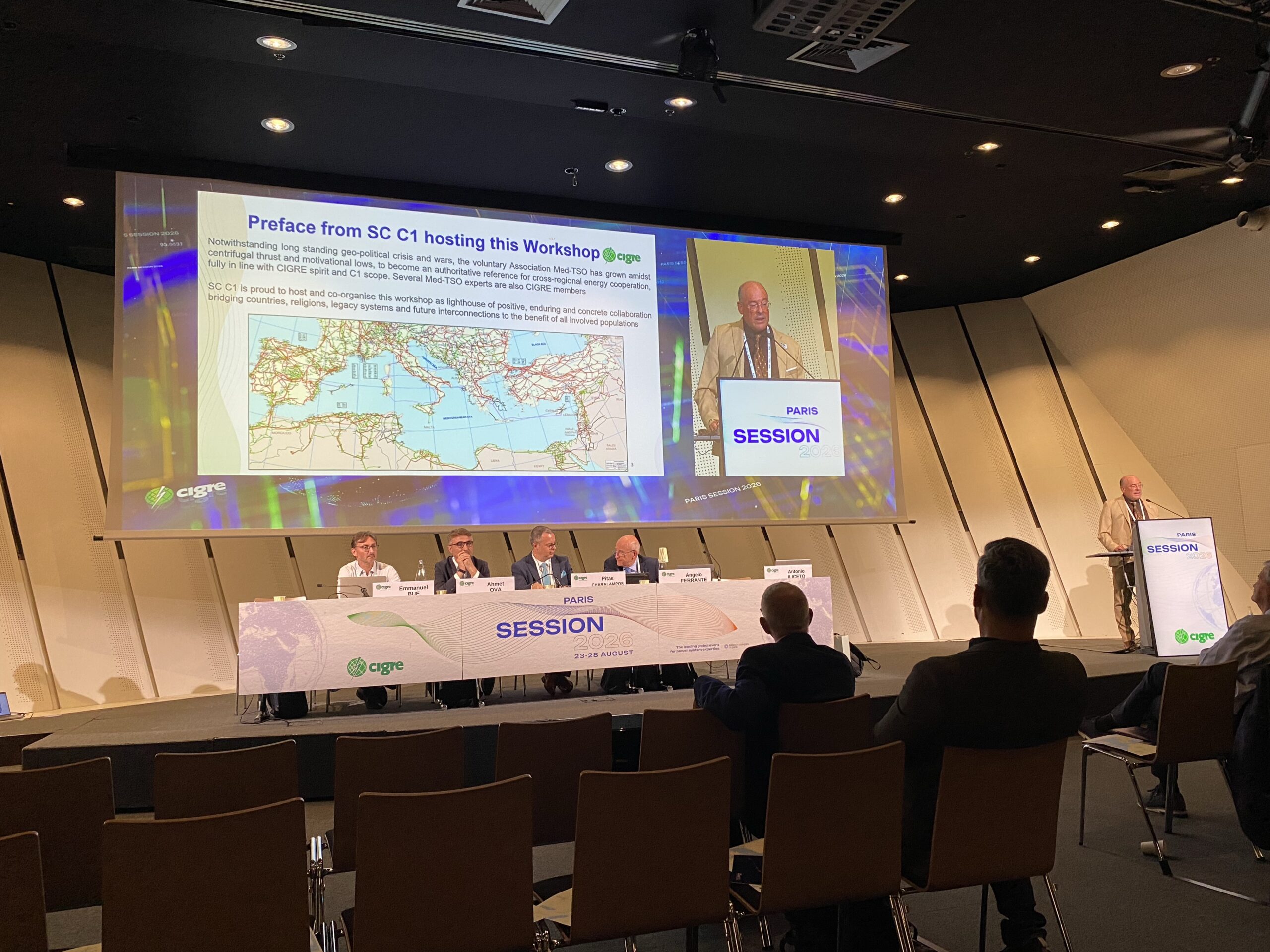
Introducing the event, CIGRE Study Committee C1 Chair, Antonio Iliceto, highlighted how notwithstanding long standing geo-political crisis and wars, the voluntary Association Med-TSO has grown amidst centrifugal thrust and motivational lows, to become an authoritative reference for cross-regional energy cooperation, fully in line with CIGRE spirit and C1 scope. He also added that the committee he chairs was proud to host and co-organise this workshop as lighthouse of positive, enduring and concrete collaboration bridging countries, religions, legacy systems and future interconnections to the benefit of all involved populations.
Opening the workshop, Secretary General of Med-TSO Angelo Ferrante presented the association’s mission, vision and strategic priorities. He emphasized that Med-TSO brings together 20 Euro-Mediterranean TSOs with the shared objective of promoting an integrated, reliable and sustainable electricity system across the region. Ferrante noted that achieving the Mediterranean energy transition requires balancing decarbonization, renewable energy growth and climate resilience while overcoming national barriers through a common regional vision. He stressed that stronger transmission networks and expanded interconnections are indispensable for supporting renewable energy deployment, strengthening energy security and increasing system efficiency. At the same time, he recalled that many existing interconnections remain underutilized because of regulatory, market and coordination barriers, making deeper regional cooperation essential for unlocking their full value.
Charalampos Pitas (IPTO, Greece), Vice-Chairperson of the Med-TSO Technical Committee “Operation”, then illustrated how Med-TSO is translating this vision into concrete action. He explained that the association promotes the development of a Mediterranean electricity market through common methodologies, harmonized rules and coordinated infrastructure planning. Building on existing cross-border connections and growing electricity exchanges throughout the region, Med-TSO’s action plan addresses the technical, regulatory and financial challenges that continue to slow integration efforts. Its activities focus on long-term planning, renewable energy integration, operational coordination, data sharing, institutional strengthening and knowledge exchange. Pitas also highlighted the strategic role of Med-TSO’s technical committees, which support planning, regulation, operations and market integration activities across the Mediterranean. The 2025 edition of the Mediterranean Master Plan of Interconnections was presented as a cornerstone of future development, identifying priority interconnection investments capable of increasing transfer capacity, reducing renewable energy curtailment and lowering carbon emissions. He also outlined the objectives of TEASIMED 3, the ongoing association’s project co-funded by the EU, which will support grid security, long-term planning, system integration, operational coordination and enhanced data sharing, while strengthening collaboration with European, Arab, African and Gulf energy organizations.
The workshop continued with a presentation by Ahmet Ova (TEIAŞ, Türkiye), Med-TSO Power Systems Advisor, who shared the results of the latest adequacy assessments and regional outlook studies. He explained that coordinated adequacy studies provide a critical tool for evaluating security of supply and measuring the benefits delivered by cross-border interconnections. Using advanced modelling techniques, demand and generation data, transmission information and specialized expertise, the assessments compare isolated and interconnected operating conditions to determine how regional cooperation improves power system resilience. The studies reveal significant changes underway across Southern Mediterranean countries. Lebanon is gradually moving from an oil-dependent electricity system toward a more diversified energy mix, Jordan is expanding renewable generation and storage capacity, Egypt is increasing capacity while diversifying through renewables, storage and nuclear power, Tunisia is preparing for evolving adequacy needs through gradual changes in demand and generation, and Morocco continues to strengthen its energy transition through increased renewable deployment. While Libya remains highly dependent on gas-fired generation, the overall regional trend points toward cleaner and more diversified power systems. The assessments also show that interconnected operation consistently improves security of supply by enabling countries to support one another through cross-border exchanges. Looking ahead to 2027 and 2030, planned interconnections are expected to further increase transfer capability, flexibility and adequacy performance throughout the region, delivering the greatest benefits under interconnected operating conditions.
The final technical session, delivered by Emmanuel Bué (RTE, France), former Chairperson of the Med-TSO Technical Committee “Economic Studies and Scenarios”, together with Charalampos Pitas, focused on scenario building and the Mediterranean Master Plan of Interconnections. The speakers presented Med-TSO’s latest scenario and planning reports, which provide the analytical foundation for regional energy development. Their outlook suggests that Mediterranean electricity demand could increase by 40 to 50 percent by 2040 as a result of economic growth, electrification and new energy uses. Installed generation capacity is expected to double, with renewable energy becoming the dominant source of electricity production. North Africa could emerge as a major green hydrogen hub supported by extensive renewable energy deployment, while regional CO₂ emissions could be cut by half compared to current levels. The speakers emphasized that such a transformation will require significant investments in transmission infrastructure and stronger cross-border integration. The updated Mediterranean Master Plan reflects the coordinated efforts of 20 TSOs and identifies strategic interconnection corridors capable of increasing transfer capacity, supporting renewable integration and strengthening security of supply. The Mediterranean Electricity Interconnection Perspective extends the analysis to 2040, examining both mature and exploratory projects. According to the study, future interconnections could provide up to 15 GW of additional transfer capacity, creating the infrastructure backbone needed to accelerate Mediterranean energy integration and deliver long-term economic, environmental and social benefits.
In his concluding remarks, Ferrante reaffirmed Med-TSO’s commitment to its 2025-2030 strategy, which focuses on grid development, renewable integration, adequacy assessment, data sharing and regional cooperation. This strategy is the backbone of the ongoing TEASIMED 3 project, whose five pillars are indeed the renewable energy integration, grid planning, system integration, data sharing and knowledge transfer, and through which Med-TSO will continue supporting the region’s energy transition. He also stressed the importance of strong coordination among policymakers, regulators, investors and system operators, noting that a successful Mediterranean energy future depends on a shared commitment to cooperation. As a technical partner of the European Union’s T-MED initiative and through expanding partnerships with African, Arab and Mediterranean institutions, Med-TSO will continue to play a central role in advancing regional planning, interconnection development and the integration of a secure, resilient and sustainable Mediterranean power system.