On 24 November, Med-TSO held its second webinar of the project outcomes series, focusing on power system adequacy and flexibility across the Mediterranean region for the horizons of Winter 2025–26, 2027, and 2030. The session provided a comprehensive overview of how Mediterranean countries are expected to respond to increasing electricity demand, higher renewable penetration, and evolving interconnection capacities in the coming years.
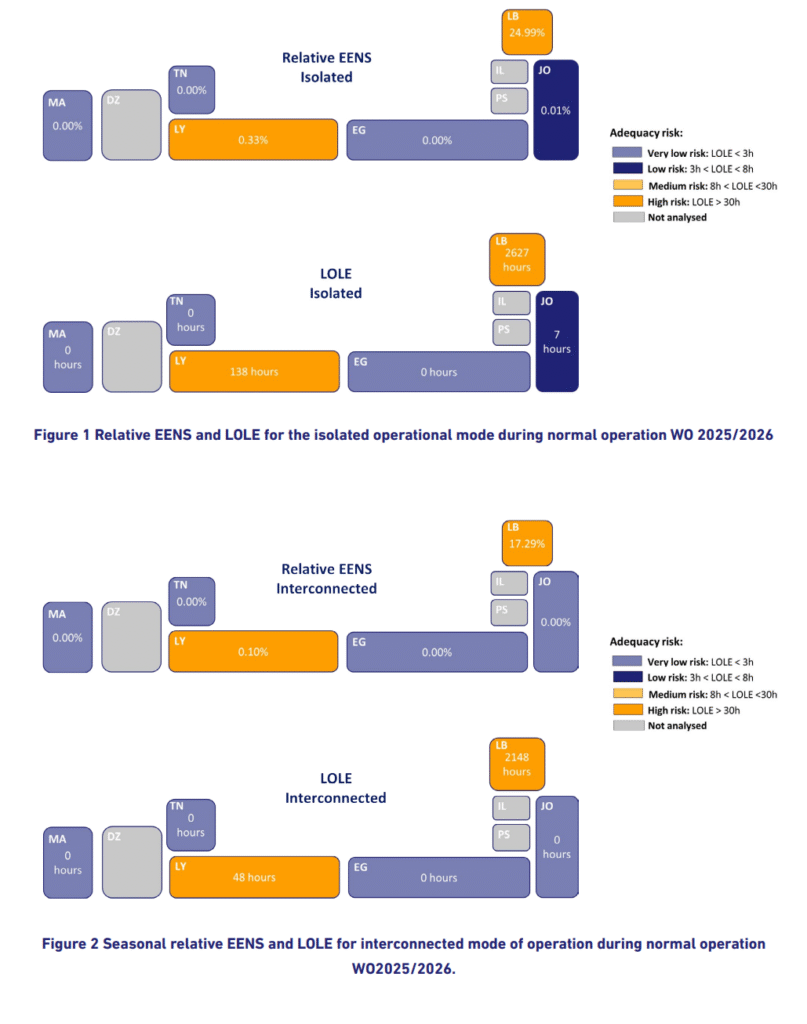
The session opened with an in-depth presentation of the Winter Outlook 2025–2026. This assessment was carried out in both isolated and interconnected modes, highlighting the resilience of national power systems and the essential role of cross-border exchanges.
The Winter Outlook 2025–2026 shows very low adequacy risks for Morocco, Tunisia and Egypt, while Libya and Lebanon face significant structural shortages. Cross-border exchanges continue to play a vital role in reducing risk, with the commissioning of the Egypt–Saudi Arabia HVDC link expected to further strengthen system security.
Results for 2027 and 2030, gathered in theMid-Term Adequacy Assessment: Horizon 2027 & 2030, indicate notable improvements driven by new capacity, more renewables and major interconnection projects such as Tunisia–Italy, Egypt–Saudi Arabia (3,000 MW), and the reinforcement of the Jordan–Syria–Lebanon corridor. By 2030, almost all countries display very low adequacy risk.
The second part of the webinar introduced a regional flexibility assessment analysing residual load variability and ramping behaviour. Flexibility needs rise significantly towards 2030 across all countries due to increased renewable integration. Importantly, the study shows that strong regional interconnections can reduce flexibility needs by roughly 30%, underscoring their strategic importance.
Participants also discussed the role of data centres, higher renewable shares and the next steps under upcoming EU-Med cooperation frameworks.
The webinar concluded by reaffirming that interconnections, data sharing and regional cooperation are essential foundations for a secure, resilient Mediterranean power system.